
1" Deflection Spring Isolator 12lbs Capacity, Orange
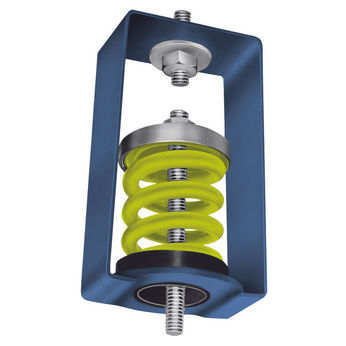
1" Deflection Spring Isolator 12lbs Capacity, Orange
Brand Mason Industries Manufacturer Mason Industries, Inc Capacity 12 lbs Early spring hangers had very stiff, tall, unstable springs and it was not unusual to sell hangers with 0.375"(10mm) deflection. Spring Hangers contained no rubber for high frequencies and the first improvement was the introduction of a rubber washer. This was normally located under the top of the box, or later on against the spring cup on top of the spring. A steel washer over the rubber washer spread the load to the outside of the steel spring so a cheaper steel cup could be used. When the rubber washer was located under the top of the box or over the steel spring, the design was still extremely poor as there was nothing to keep the rubber washer centered on the steel cup. Thus, the steel hanger rod would rub the steel cup or the steel hanger box and short circuit the action of the rubber. This was not recognized as a worry in that era, so the next step was to increase the deflection. Since spring stability was not clearly understood increased deflection was accomplished by making the springs taller, but not necessarily larger in diameter. The springs could not collapse or fall over because the lower hole in the box continued to be conveniently small. When the spring tended to topple, the rod would hit the side of the box and stop. Of course, the rubber continued to be short circuited and often the rods would lock vertically (especially if they were fully threaded) so that the springs were bypassed as well.
We reduced these problems by writing specifications and manufacturing hangers with the hole in the bottom of the hanger box as large as the I.D. of the spring. The HS Spring Hangers evolved using our
standard A, B and C Springs and seating them in LDS cups with projecting bushings to line the hole in the lower end of the box. A, B and C Springs are designed for horizontal stiffness as described on Page 1, 4, 5 and 8 of Bulletin SLF-200, so they do not fall over or buckle. Centering the spring in the acoustical cup made steel-to-steel contact of the rod and the top steel cup unimportant and put the rubber in the right location on the leaving end of the spring.
LDS stands for Low Dynamic Stiffness Bridge Bearing Natural Rubber to minimize noise and vibration transmission.
Call For Pricing
Request a quote for more detailed pricing including freight and taxes.
Brand Mason Industries Manufacturer Mason Industries, Inc Capacity 12 lbs Early spring hangers had very stiff, tall, unstable springs and it was not unusual to sell hangers with 0.375"(10mm) deflection. Spring Hangers contained no rubber for high frequencies and the first improvement was the introduction of a rubber washer. This was normally located under the top of the box, or later on against the spring cup on top of the spring. A steel washer over the rubber washer spread the load to the outside of the steel spring so a cheaper steel cup could be used. When the rubber washer was located under the top of the box or over the steel spring, the design was still extremely poor as there was nothing to keep the rubber washer centered on the steel cup. Thus, the steel hanger rod would rub the steel cup or the steel hanger box and short circuit the action of the rubber. This was not recognized as a worry in that era, so the next step was to increase the deflection. Since spring stability was not clearly understood increased deflection was accomplished by making the springs taller, but not necessarily larger in diameter. The springs could not collapse or fall over because the lower hole in the box continued to be conveniently small. When the spring tended to topple, the rod would hit the side of the box and stop. Of course, the rubber continued to be short circuited and often the rods would lock vertically (especially if they were fully threaded) so that the springs were bypassed as well.
We reduced these problems by writing specifications and manufacturing hangers with the hole in the bottom of the hanger box as large as the I.D. of the spring. The HS Spring Hangers evolved using our
standard A, B and C Springs and seating them in LDS cups with projecting bushings to line the hole in the lower end of the box. A, B and C Springs are designed for horizontal stiffness as described on Page 1, 4, 5 and 8 of Bulletin SLF-200, so they do not fall over or buckle. Centering the spring in the acoustical cup made steel-to-steel contact of the rod and the top steel cup unimportant and put the rubber in the right location on the leaving end of the spring.
LDS stands for Low Dynamic Stiffness Bridge Bearing Natural Rubber to minimize noise and vibration transmission.